
State surveillance an ‘attack on public interest journalism’, says NUJ member Vincent Kearney as tribunal hearing begins
The Investigatory Powers Tribunal (IPT) today heard of unlawful surveillance against former BBC journalist and National Union of Journalists (NUJ) member Vincent Kearney.
The three-day hearing, taking place at the Royal Courts of Justice in London, follows an admission by MI5 that it had illegally obtained communications data from Kearney’s phone on two occasions in 2006 and 2009 while he was BBC Northern Ireland’s home affairs correspondent.
Earlier, Kearney’s counsel Jude Bunting KC outlined the considerable impact of unlawful surveillance on Kearney’s professional reputation, his capacity to protect his sources, his personal and private life, and his ability to do his job - subjecting him to considerable risk as a journalist working in a post-conflict society.
Laura Davison, NUJ general secretary, said:
“At the heart of the revelations today was the approach of the PSNI to Vincent Kearney and his role as a journalist. As his counsel pointed out, Vincent Kearney was treated as a criminal suspect and all established legal precedents for the treatment of journalists were clearly set aside. Alarmingly, it is obvious that family members were also caught in the unlawful surveillance net.”
Before the hearing, Kearney, who is now the Northern Ireland editor for RTÉ News, said this unlawful state surveillance amounted to not just an attack on him, but an attack on public interest journalism.
Vincent Kearney said:
"This process has confirmed that I was the target of a long and consistent campaign of unlawful interference with my confidential journalistic material by the PSNI, MI5 and other public authorities while working for BBC Northern Ireland.
"The extent of the admitted illegal monitoring of my communications data over a period of many years in an attempt to identify sources was shocking and stark and it’s likely there was more than has been publicly conceded.
"This conceded illegality has had a real and significant impact and has had a chilling effect on my ability to carry out public interest journalism. Former colleagues in the BBC have also suffered damage to source relationships.
"These activities were not just an attack on me and my journalism, but also the journalism of the BBC and on public interest journalism itself. Journalists must be free to pursue their lawful duties without fear of illegal efforts by the state to drive a coach and horses through source confidentiality, which is an essential journalistic tenet."
Kearney’s case arose in a separate IPT hearing, which ruled in December 2024 that the surveillance of NUJ members Trevor Birney and Barry McCaffrey by both the Police Service of Northern Ireland (PSNI) and the Metropolitan Police was unlawful.
Laura Davison added:
“These revelations involving state surveillance of journalists in the UK are deeply disturbing. Vincent Kearney’s case underlines the union’s concern over the conduct of police and security authorities, and the apparent disregard for journalists’ right to protect their sources.
"This information wouldn’t have come to light without Vincent’s courage and the support of the BBC and his current employer RTÉ. The Investigatory Powers Tribunal process is secretive, protracted and costly, taking a significant toll on the wellbeing of our members.
“The NUJ once again demands a broader, independent investigation to uncover the full extent of surveillance against journalists in Northern Ireland - not only by PSNI but also other police forces and security services.”
In September 2025 the McCullough Review into covert measures by the PSNI against journalists in Northern Ireland was published. The NUJ welcomed the PSNI’s acceptance of the review's recommendations and called for a judge-led inquiry to investigate the full extent of systemic, unlawful surveillance against journalists, lawyers and human rights defenders in Northern Ireland.
Séamus Dooley, NUJ assistant general secretary, said:
“NUJ members everywhere but especially in Northern Ireland stand in solidarity with Vincent Kearney and the BBC at this time. Vincent stands in a line of journalists placed under surveillance because they dared to do their job.
“It is profoundly disturbing but not surprising to be back at the IPT awaiting details of further evidence of abuse of power by those vested with protecting freedoms. There must be accountability and consequences for these actions.”
Both Davison and Dooley attended the first day of the hearing in support of Kearney, who has received messages of solidarity from across the union.
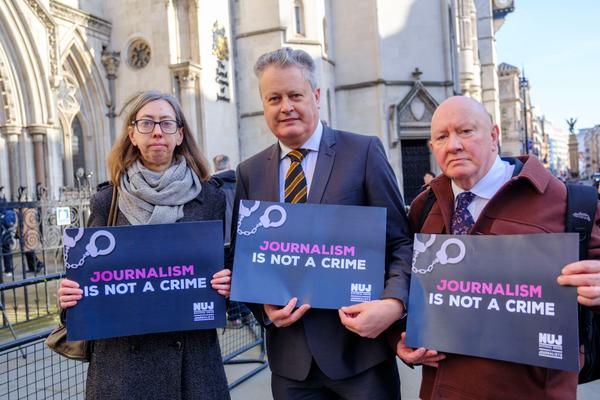
Vincent Kearney, Laura Davison and Séamus Dooley holding 'Journalism Is Not A Crime' signs outside the Royal Courts of Justice
© Jess Hurd
Fran McNulty, NUJ joint president, said:
“Public service journalists, like all journalists, must be able to pursue stories, investigate issues and engage with sources without any fear of surveillance and intrusion by the state. What has been uncovered in Vincent’s case is of the utmost concern. The pursuit of Vincent was entirely counter to the public interest and I with all journalists express solidarity with him, and assure him of the NUJ’s unwavering support.”
Kevin Cooper, Belfast & District branch vice chair, said:
“Our thoughts are with Vincent Kearney, an NUJ Belfast & District Branch member, who is having his case heard against the PSNI and MI5 in London over the next few days. NUJ members stand in solidarity with Vincent at this time. Journalism is not a crime and the British state, police and agencies have no right interfering with journalists going about their lawful business and doing their jobs on behalf of the public.”
Press coverage:
- PSNI admits illegally keeping journalist data and family names
- PSNI created detailed profile of journalist, court told
- ‘Attack on public interest journalism’: RTÉ editor’s surveillance case opens in London
- PSNI and MI5 unlawfully obtained phone data of prominent Northern Ireland journalist, tribunal hears
- Police created ‘intelligence profile’ of BBC journalist subject to phone surveillance
- RTÉ journalist Vincent Kearney spied on by PSNI, MI5 and Met Police over eight years
- Police and MI5 waged campaign of illegal interference against BBC journalist, tribunal told
- RTÉ journalist whose data unlawfully gained should get damages, tribunal told