
TUC Disabled Workers’ Conference 2026
The NUJ’s motion on addressing career barriers for young disabled workers in journalism and the creative industries passed unanimously at the 2026 TUC Disabled Workers’ Conference.
The conference, held on 19-20 May at Bournemouth International Centre, was Ann Galpin’s last as the NUJ representative on the TUC Disabled Workers’ Committee. Galpin was thanked for her 16 years of service by Kate Bell, TUC assistant general secretary. The NUJ delegation - Lynn Degele, Gemma-Louise Stevenson, and Johny Cassidy - paid tribute to Galpin’s work, and welcomed the fact she will continue as co-chair of the NUJ Disabled Members’ Council.
Delegates stressed the urgent need for stronger workplace protections and accessibility. Seconding a motion responding to the government’s ‘Keep Britain Working Review’, Lynn Degele condemned the closure of the Access To Work email contact system since 1 May, warning that removing accessible communication methods risks excluding disabled workers from essential support.
Degele argued that the focus must shift from disabled people advocating for themselves to employers fulfilling their responsibilities. She said that giving employers seven years to introduce reasonable adjustments is too long and urged trade unions to campaign together for faster implementation. The motion passed unanimously.
Conference heard a powerful contribution from Gemma-Louise Stevenson speaking in support of a composite motion on equity and access in the arts industry. Stevenson drew on her own experience of becoming a wheelchair user and being warmly welcomed into sports journalism while encountering exclusion in the world of theatre.
Stevenson said:
“It’s a battle - one of having to constantly fight for equal access to opportunities; individually having to research into access before accepting a contract; and in order to actually take that contract, having to navigate an Access to Work system that has so many delays we could have lost the contract before they even get to our case.
“And that is why this motion is so important. Let’s work for better and more equal outcomes for disabled creatives, because when disabled people can be 'astonishing’ and create, produce and perform theatre and art, we can change attitudes and create lasting change long after the final curtain falls.
“Because if we support that in the arts industry, who knows how much it can impact practice in other industries like my own - where, as one of the first wheelchair users working in women’s football reporting, my decision-making on whether a match should be covered is still influenced more by how accessible the stadium is than the actual stories within the game.”
Her speech received rapturous applause and the motion was passed unanimously.
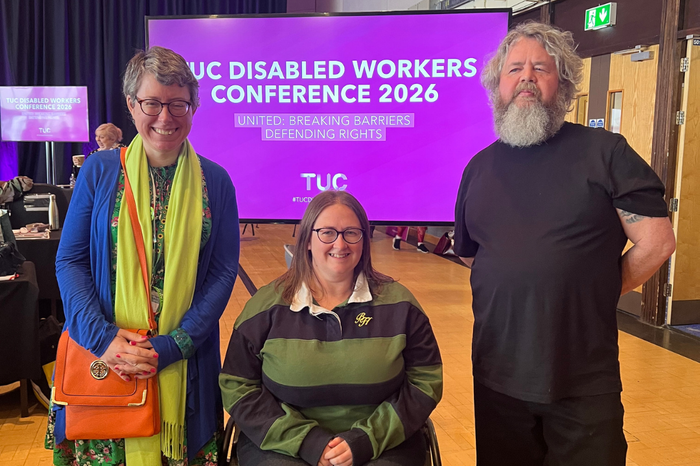
Lynn, Gemma-Louise, and Johny.
On day two of the conference, Stevenson seconded an emergency motion by the National Association of Schoolmasters Union of Women Teachers (NASUWT) on protecting access to mobility for disabled workers. The motion addressed concerns around the privacy and accuracy of the Drive Smart scheme, where there have been reports of disabled drivers being incorrectly assessed and removed. The motion also highlighted proposals to strictly limit new mobility leases to 10,000 miles per year and increase excess mileage charges to 25p per mile.
Speaking for a motion on reasonable adjustments in the workplace, Lynn Degele said: “reasonable adjustments can be the difference between someone remaining in work and being managed out of employment.” Degele said it is crucial that the trade union movement continues to raise awareness of reasonable adjustments and places disabled workers at the centre of campaigns.
Johny Cassidy proposed the NUJ’s motion on breaking down career obstacles for young disabled people in journalism and creative sectors. Cassidy emphasised systemic barriers such as a lack of access to suitable housing, transport, healthcare and social support that reduce opportunities to secure employment.
He also highlighted the lack of inclusivity and affordability for young people to undertake work experience and volunteering opportunities needed to secure work in journalism and creative sectors.
Cassidy said:
“It was great to be able to forward the NUJ motion about ending the culture of working for free in newsrooms, which we know precludes far too many people, including disabled people, from entering the industry.
“If we want the stories of disabled people to be told authentically and truthfully, we need to have those people in our newsrooms, and not only at entry levels. We need editorial decision makers to understand through their own lived experience to challenge the negative rhetoric that has become all too pervasive across society.
“It’s time we reclaimed the narrative and told our own stories.”
The motion passed unanimously.