
TUC Women’s Conference 2026
The NUJ’s motion highlighting the harm caused to women by far right, racist and sexist rhetoric passed at this year’s conference.
Held at Bournemouth International Centre from 4-6 March, the conference focused on tackling misogyny and sexism and how the trade union movement can counter the threat of the far right.
Day one
The NUJ delegation was Ann Galpin, Georgina Morris, Natasha Hirst, and Sara Lewis. Natasha Hirst, NUJ Equality Council co-chair, moved the NUJ’s motion - which was composited with other unions' motions - speaking powerfully on the rise of the far right and the weaponisation of women’s and girls’ safety in political discourse.
Hirst emphasised the role of journalists in resisting narratives that scapegoat marginalised communities. She noted that “our members are increasingly at risk from members of the far right when at work, both online and in person.”
The NUJ launched a Journalists’ Safety Tracker in 2024 and the responses reveal a concerning pattern of violent, graphic abuse directed at women journalists with some women reporting “daily rape and death threats” as well as public photos being doctored in a sexually explicit manner and then widely shared online.
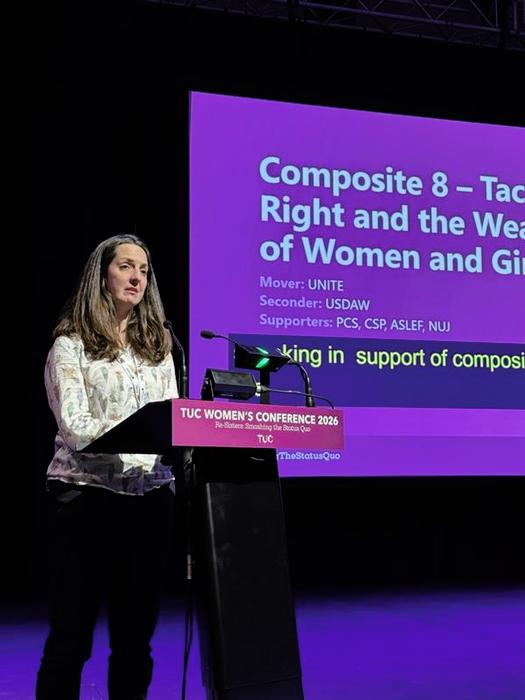
Natasha Hirst speaking at the TUC Women's Conference 2026.
Hirst said:
“This level of abuse risks silencing the voices of diverse women journalists. There has never been a time when plurality of viewpoints in the media has been so crucial.
“It's vital that we all take action to challenge misogyny, racism, ableism and all other forms of discrimination and hatred that create harm and division. As journalists and communications professionals, we bear a responsibility to shape positive and inclusive narratives and to scrutinise and challenge attempts to undermine the rights and safety of women and girls.”
Hirst highlighted the importance of ethical reporting and storytelling in securing justice for survivors of misogyny and abuse. Put into practice, this means reporting accurately, fairly and sensitively and always challenging disinformation.
She ended the speech reminding conference of the hope that trade unionists bring to those who need it: “We can never be complacent about our rights, and our fight for equality and safety must be an intersectional and inclusive one.”
The motion was seconded by the Union of Shop, Distributive and Allied Workers (USDAW) and delegates from Public and Commercial Services Union (PCS), The Chartered Society of Physiotherapy (CSP), and Associated Society of Locomotive Engineers and Firemen (ASLEF) also spoke in support of the motion.
The motion carried unanimously.
Day two
Georgina Morris, NUJ vice president, delivered a speech as part of the group debates on ‘Dangers of AI synthetic images of women’, ‘Combatting Misogyny in Artificial Intelligence,’ and ‘Ending Digital Violence against Women and Girls.’
The motions called on the Women's Committee to raise awareness of digital violence as a form of workplace harassment and advocate for ethical standards in the deployment of AI to protect women's rights.
Morris highlighted the NUJ’s calls for urgent regulatory oversight promoting ethical approaches that centre the work of journalists. Research from the Journalists’ Safety Tracker reveals that women journalists disproportionately face harassment and abuse focused on their appearance, including sexual violence and deepfake pornography.
Morris said:
“Our members working in social media roles are exposed to this hateful rhetoric on a daily basis, facing the unenviable task of wading through comment sections on platforms that have allowed harmful content to flourish.
“Employers have a legal duty to protect us from all these harms, but too many have no effective procedures or support systems in place.
“We wholeheartedly back the call for workplace campaigns to raise awareness of the health and safety risks and for strong UK laws that hold to account both the individuals responsible for digital violence and the platforms that make a profit from it.”
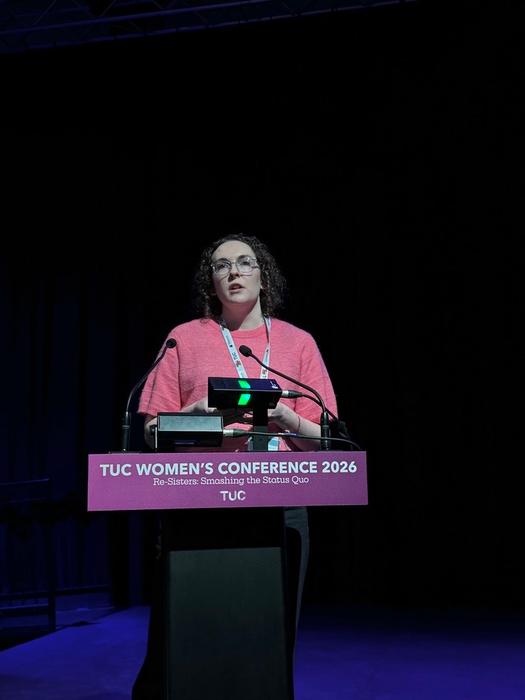
Georgina Morris speaking at the TUC Women's Conference 2026.
The NUJ formally Prospect’s motion in the group debate on tackling inequality for freelances and self-employed workers in the creative industries.
Sara Lewis, Equality Council vice-chair, spoke about her experience as a freelance journalist and the “difficulties of the motherhood penalty.” She said that women were much more likely to choose self-employed work because of caring commitments, as well as noting the difficulties experienced by disabled people, which can makes self-employment the only feasible work option for some.
Lewis said: “Although we are our own bosses in theory, in practice there is a massive power imbalance, which is why it’s so important that the trades union movement understands and is responsive to the needs of self-employed workers.”
The motion passed with the TUC instructed to lobby government and campaign for fair pay, flexible working standards and family-friendly working rights for freelances in the creative industries.
Day three
On the final day of conference, delegates backed motions on supporting carers in the workplace, health and safety, and reproductive justice.
A composite motion on improving maternity and paternity rights, moved by UNISON and seconded by USDAW, was carried unanimously. ASLEF’s motion promoting flexible learning within the trade union movement was also carried.
Workplace health was another key theme. A composite motion on women’s occupational health and safety in the workplace was moved by the Communications Workers Union (CWU), while a motion calling for reproductive justice to be recognised as a workplace issue was moved by the University and College Union (UCU).
The speaker shared an upsetting example of a teacher and UCU member who was expected to return to work immediately after experiencing a miscarriage. When she went to the toilets to cry, the headteacher told her to “wipe your tears and get back in that classroom. We have no one else to cover the lesson.”
The speaker emphasised the need to prioritise and secure reproductive healthcare, “especially as the threats of the far right gather pace.” She continued: “Reproductive justice is a workplace issue and it is our job as trade unions to organise for it and to not shut up or be shut up about it.” The motion carried unanimously.
Composite 8, ‘Tackling the Far Right and Weaponisation of Violence against Women and Girls’ - which was co-sponsored by the NUJ on day one of the conference - was the motion selected to go to the TUC Congress in Brighton in September.
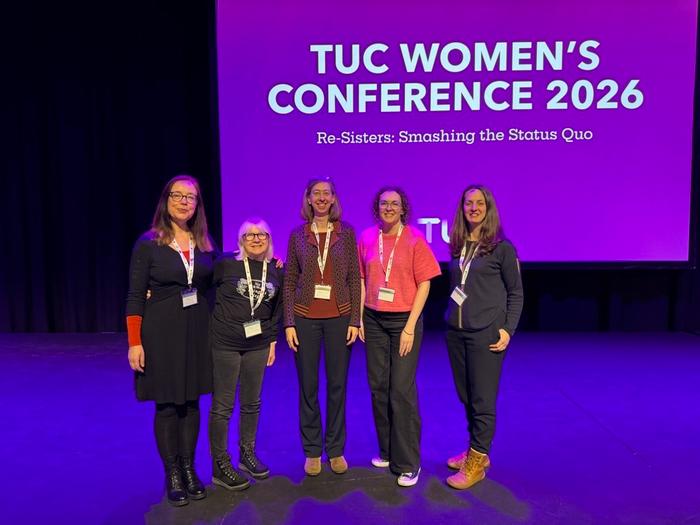
Left to right: Ann Galpin, Sara Lewis, Laura Davison, Georgina Morris, Natasha Hirst.