
TUC Black Workers’ Conference 2026
The NUJ’s Black Members’ Council (BMC) emphasised the need for accurate, ethical reporting to counter racist narratives at the TUC Black Workers’ Conference 2026.
Held at the Bournemouth International Centre from 24 to 26 April, the conference opened with a series of emergency motions expressing opposition to the war on Iran, noting the effect of the war on the cost-of living crisis, and calling for a permanent ceasefire.
Kate Bell, TUC assistant general secretary, highlighted that 40% of Black workers experience racist abuse at work, and over a third face verbal or physical attacks.
Bell linked this abuse to the failure of social media companies to prevent the spread of discrimination on their platforms. She said: “Tech platforms give voices to those like Tommy Robinson which enables hatred and creates a hostile environment for Black people. Nigel Farage wants to rip up the Equality Act that protects all of us. We say no to the politics of division, no to the far right, and no to racism.”
The NUJ’s delegation was Roger McKenzie, BMC co-chair, and Saadeya Shamsuddin, BMC treasurer.
Moving the NUJ’s motion, titled ‘Resisting the Far Right and Racist Narratives', Shamsuddin said:
“We are in a moment where parts of our political and media landscape have made anti-immigration, anti-Muslim and anti-Black rhetoric not just acceptable, but mainstream.
“We are seeing more Black and brown faces in positions of power being used - and in some cases choosing - to uphold systems of white supremacy that continue cycles of inequality at the highest levels.
“You can argue it has always been this way. But right now, because of what is happening globally and the impact it is having on people like you and me, the stakes are higher.
“We need journalism with integrity.”
The motion noted the scale of anti-immigration protests in the past year, with over 110,000 people attending the ‘Unite the Kingdom’ rally in London on 13 September, driven by a coalition of neo-fascist groups and online disinformation. While the Together Alliance march was an historic, uplifting demonstration of anti-racist resistance, the trade union movement must continue to mobilise opposition and sustain action.
The motion called on the TUC to organise a national demonstration uniting trade unionists and communities; to lobby the government to push back against divisive rhetoric; and to promote media literacy alongside the NUJ's race reporting guidelines. The motion was carried unanimously.
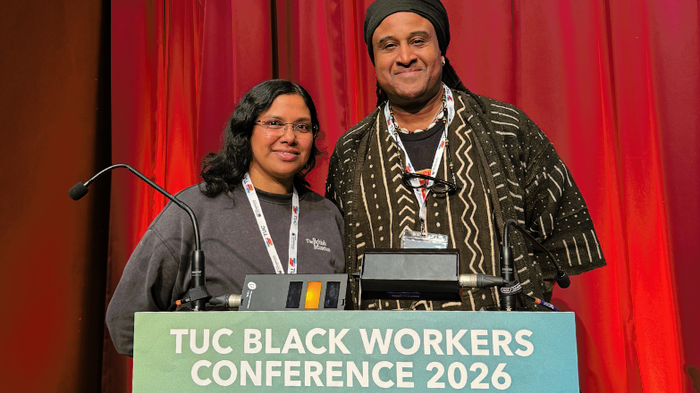
Saadeya Shamsuddin and Roger McKenzie at the conference.
© Alex Slater
The importance of the union’s race reporting guidelines and Code of Conduct were also highlighted during a separate motion on the rise in racist language and abuse, which called for accountability from politicians, the media and the trade union movement itself.
McKenzie warned that the normalisation of racist rhetoric in public discourse must be challenged and that confronting racism requires consistency.
“We have to call them all out - not only politicians for spewing the same words as Enoch Powell in 1968 - but also within our trade unions,” he said.
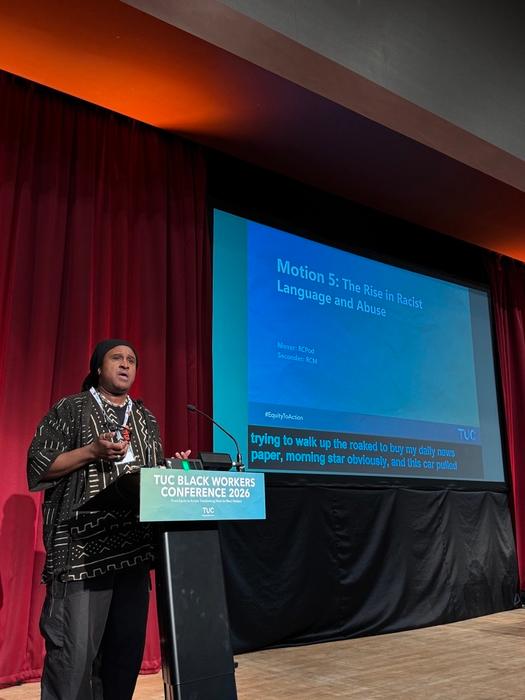
Roger McKenzie speaking at the conference.
© Alex Slater
McKenzie stressed the need to follow the union’s guidelines, particularly at a time when misinformation and hateful narratives are widespread, and argued that journalists must be at the forefront of calling out racism in the media. His contribution was met with strong applause from the floor. The motion was carried without opposition.
The NUJ delegation later seconded a further motion on media reporting standards by the Fire Brigades Union (FBU). Shamsuddin said:
“I’ve been struck over the course of this conference by how many delegates have spoken about the racism they are not just observing, but experiencing,
“And again and again, we’ve heard how media coverage plays a role in that through headlines, through framing, through the way stories are told.
“Because this isn’t just about overt racism. It’s the subtle bias, the disproportionate way Black people are represented in crime reporting, the selective naming of ethnicity, the narratives that quietly reinforce the idea of our communities as ‘other’.”
Shamsuddin pointed to the lack of diversity in senior editorial roles, noting that decision-makers in newsrooms remain overwhelmingly white, arguing that this directly shapes how stories are told and which perspectives are prioritised or excluded.
Shamsuddin also argued that regulation must be strengthened and meaningfully applied. Clause 12 of the Independent Press Standard Organisation’s (IPSO) Editors’ Code of Practice covers discrimination complaints against named individuals, including on the basis of race. However, between September 2014 and 31 December 2023 IPSO only upheld three discrimination complaints with zero cases upheld on the grounds of racial discrimination. The NUJ argues that Clause 12 should be better enforced and extended to cover discrimination against groups, not just individuals.
The motion called upon the TUC to work with the NUJ to promote its race reporting guidelines; engage with the NUJ Black Members’ Council to strengthen the application of Clause 12; challenge IPSO enforcement outcomes where Clause 12 complaints result in no breach findings and lobby government for improvements to the Editors’ Code, while respecting freedom of expression. The motion was carried unanimously.
A series of motions on workplace issues were passed unanimously over the three-day conference. These included calls to improve diversity in senior roles, build a stronger anti-racist movement, and tackle microaggressions at work by recognising it as a health and safety issue rather than just an equality issue. Delegates shared personal experiences, underlining how everyday incidents contribute to hostile working environments.
The conference closed with a renewed commitment from unions to organise, challenge and build a stronger, united anti-racist movement.