
Nesrine Malik delivers 2026 Claudia Jones Memorial Lecture
The NUJ Black Members’ Council (BMC) held a successful event to celebrate pioneering journalist Claudia Jones and this year’s George Viner Memorial Fund scholars.
Held at the Canal Museum in London on 20 October, the annual lecture in Jones’ honour was delivered by Guardian columnist Nesrine Malik.
In a wide-ranging speech - which covered austerity, culture wars, the rise of the far right, institutional racism, and the death of Professor Jason Arday - Malik posed a question: “What is journalism for?”
The Sudanese-British journalist stressed the need to “make space” to reflect the simultaneously diverse and distinctive experiences of the Black diaspora. In working with colleagues on the Guardian’s Long Wave newsletter, Malik comes across stories “connected by similar histories that often shock myself and the team with the specificity of practices, ways of living and challenges on entirely different continents.” These connections include shared linguistic heritage, musical influences, resistance politics, and even mystical pre-Abrahamic practices.
To draw out the co-existing identities of the Black diaspora, Malik retraced her own journey from Sudan to the UK. After growing up under harsh sanctions and the persistent post-colonial influence of “Western European hegemony”, she moved to the UK in her mid-20s to complete a postgraduate degree. Malik then got “a cool job” and eight years ago she became a British citizen. This was only after “broadly terrible and precarious” dealings with the UK Home Office.
At the start of her career in British journalism, Malik felt “constricted” by “a gamified, unserious, malicious media and political environment.” She elaborated that “most Black journalism functions within white-governed institutions and a white media so we have to be aware and vigilant to the pressures of that.”
While it’s easy to feel “trapped”, “kettled” or “pigeonholed” as a Black journalist, Malik said it is possible to navigate this environment without being subsumed by reactionary, regressive narratives around race and Black lives.
She described being “opened up” by the possibility that journalism - just like history, music, festivals, and activism - can foster “community and gathering”. This, she said, is the essence of what Claudia Jones created. “This gathering is a form of relating to each other and having a baseline affection and care for each other.”
Reflecting on Jones’ legacy, Malik said:
“Jones dedicated her journalistic endeavours in the West Indian Gazette to anti-racism in the UK, but fostered dialogue between West Indians and international freedom movements. And in establishing the Notting Hill Carnival, she also galvanised a form of Black culture that insists on endurance on its own terms. In these forms of thinking, writing, organising and community-building, we might find that space for manoeuvre […] That space to be Black and care and write about racism because it is simply a fact of one’s life, underrepresented in an overwhelmingly white media landscape. That space to do so without being limited by it and defined by it as a professional. And that space to be confident, ambitious and global with our own stories.”
Malik returned to the question she posed at the start of her Lecture. What is journalism for? “To exist on your own terms.”
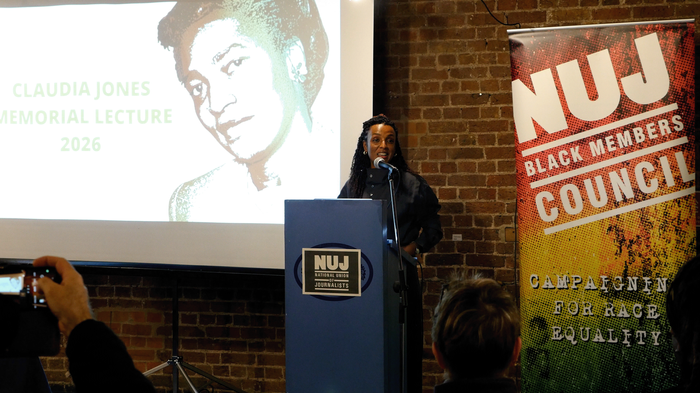
Nesrine Malik at the Lecture.
© Belgi Alidor
The Lecture was preceded by the George Viner Memorial Fund (GVMF) ceremony. Jim Boumelha, GVMF trustee, noted that the NUJ’s charity - which launched in 1987 - is one of the oldest initiatives aimed at furthering race equality in the media and had led to the establishment of similar funds by media organisations and the National Council for the Training of Journalists (NCTJ).
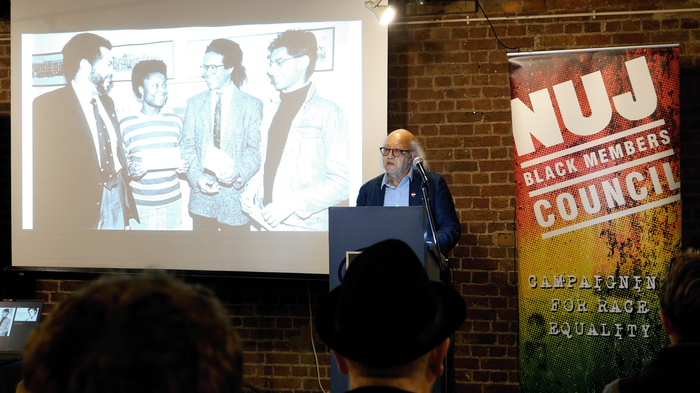
Jim Boumelha introduces the George Viner Memorial Fund.
© Belgi Alidor
Boumelha introduced 2025 scholars Meena Iyer and Hana Williams, who said the Fund had made it possible to complete a Master’s in broadcast journalism. After completing a two-week internship at the Guardian, Williams is now a freelance working as a social producer on the publication’s podcasts. “I owe it all to the NUJ and the George Viner Memorial Fund. It’s truly changed my career prospects.”
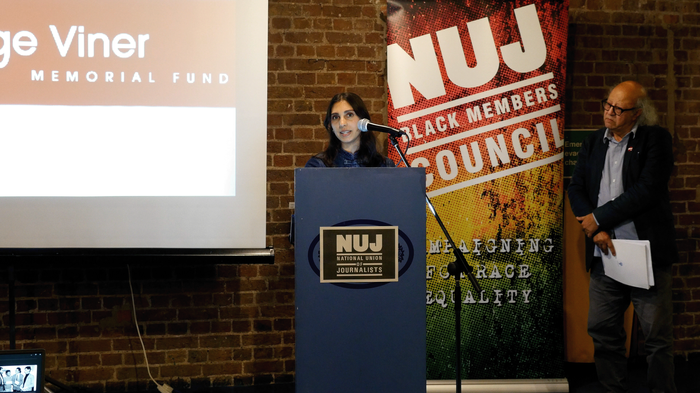
Hana Williams, GVMF 2025 scholar.
© Belgi Alidor
Iyer similarly credited the Fund for enabling her to pursue a career in journalism. Having worked as a consultant in the development sector, Iyer enrolled on a journalism Master’s at Goldsmiths and is now on an “unexpected path” after becoming “captivated” by court reporting through her course. “As a recipient of this 40-year legacy of diversity that this Fund symbolises, I now hope as a journalist to continue working for representation in the industry,” she said.
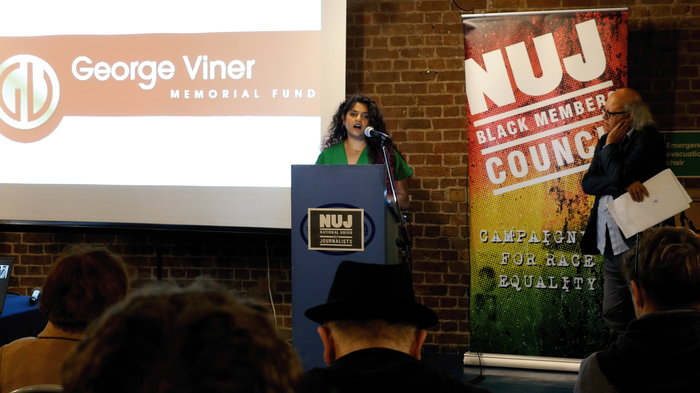
Meena Iyer, GVMF 2025 scholar
© Belgi Alidor
The ceremony concluded with Laura Davison, NUJ general secretary, presenting gifts to Williams and Iyer alongside 2026 scholars Adam Wu, Nathanael Lawrence, and Maria Khan.
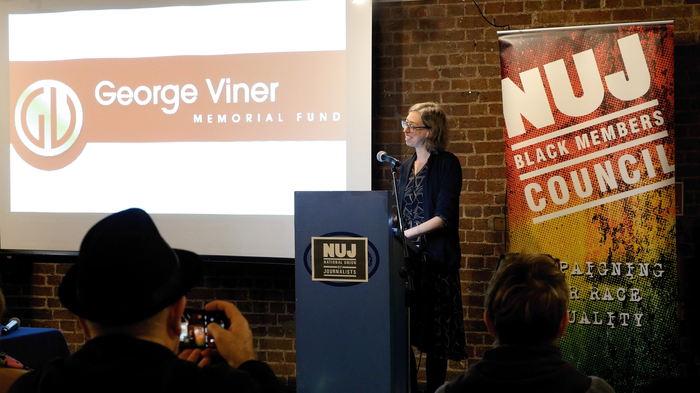
Laura Davison, NUJ general secretary.
© Belgi Alidor
Roger McKenzie, BMC co-chair, ended the evening with a passionate plea for journalists to get involved in the union to build community, organise in the workplace and stand alongside colleagues fighting for their jobs amid mass cuts. “The only way to make a difference is by getting involved in the union - let’s get something done collectively.”
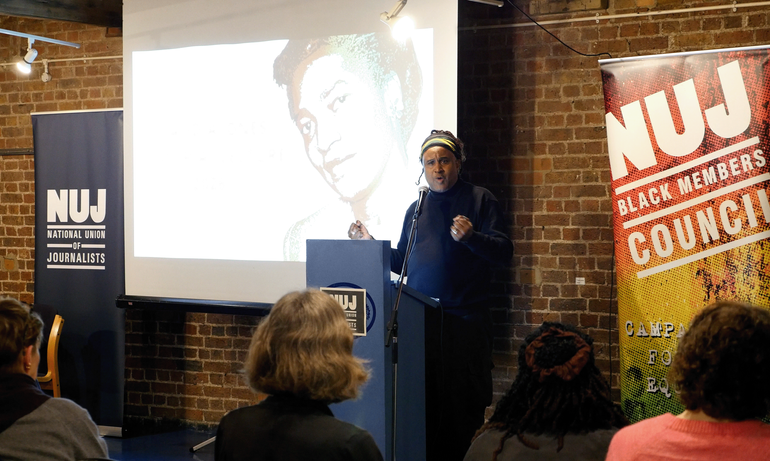
Roger McKenzie, BMC co-chair.
© Belgi Alidor
Nesrine Malik answers questions from audience members.
© Belgi Alidor
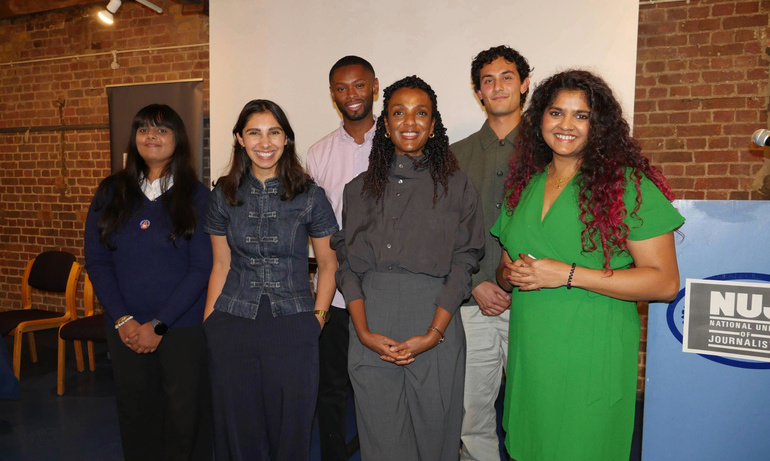
Nesrine Malik with George Viner Memorial Fund scholars.
© Belgi Alidor
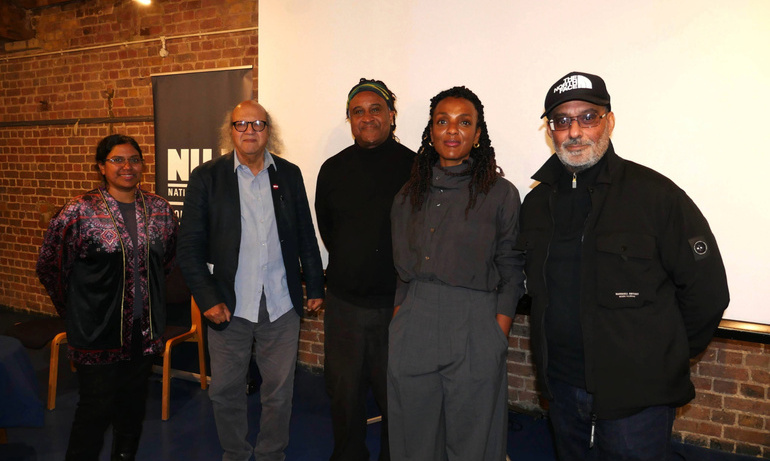
Nesrine Malik with officers of the NUJ Black Members' Council.
© Belgi Alidor
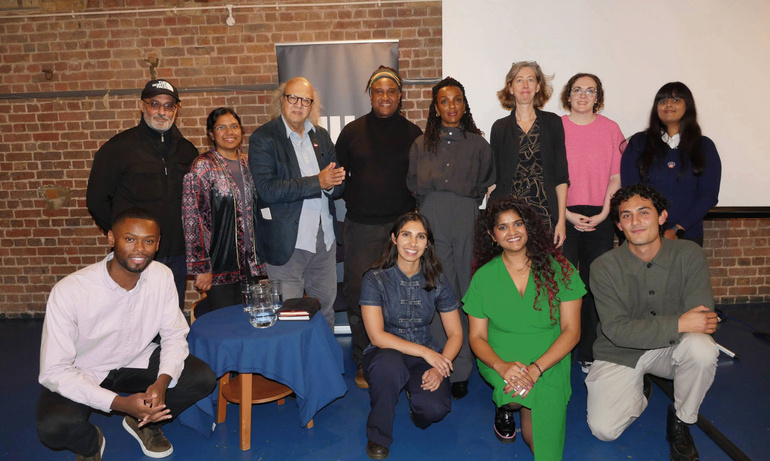
Top row: Tony Adams, Saadeya Shamsuddin, Jim Boumelha, Roger McKenzie, Nesrine Malik, Laura Davison, Georgina Morris, Maria Khan. Bottom row: Nathanael Lawrence, Hana Williams, Meena Iyer, Adam Wu.
© Belgi Alidor