
Vincent Kearney treated as a ‘suspect’
Séamus Dooley, NUJ assistant general secretary, looks back on day one of this week’s Investigatory Powers Tribunal hearing of the case taken by union member Vincent Kearney and the BBC against the Police Service of Northern Ireland.
“That was a clumsy description.”
Clumsy.
The word reverberated through the sedate, intimate setting of Court 72 where the Investigatory Powers Tribunal (IPT) resides, tucked away in an almost hidden corner of the Royal Courts of Justice in the heart of London.
At the IPT the Police Service of Northern Ireland (PSNI) has admitted that the force illegally obtained phone data from Vincent Kearney and created a "profile" of the then BBC journalist.
In one operation it amassed information relating to 1,580 calls or texts the NUJ member made and received, while its profile on him contained details about his family, phone numbers, car registration numbers and who was residing at his family home. It's hard to imagine a more intrusive exercise directed at a journalist.
The sole objective of the actions was to identify his journalistic sources yet records show that Kearney was referred to as a “suspect” in a criminal investigation.
The PSNI may have admitted unlawful actions but no apology has been forthcoming, and they are objecting to the claim for damages lodged by Kearney and the BBC.
At yesterday’s hearing Cathryn McGahey KC, for the PSNI, said the force had made “a number of clear and extensive concessions.” The force did not object to the tribunal ruling that the PSNI breached Kearney and the BBC’s rights, she said, but it opposed the awarding of damages as it would be unnecessary “to award just satisfaction”.
The PSNI concession, she argued, was sufficient in and of itself.
Questioned by the IPT on the description of Vincent Kearney as a “suspect” in a criminal investigation, McGahey said that description was wrong and should not have been used. It was, she said, "a clumsy description.”
Clumsy is a word normally associated with an unfortunate and usually inconsequential accident, such as spilling a cup of coffee on a charge sheet or stepping into a puddle of water on the way to court.
Labelling a respected journalist as a “suspect” was more than just clumsy.
Vincent Kearney was not a suspect.
His contacts were not criminal.
Journalism is not a crime.
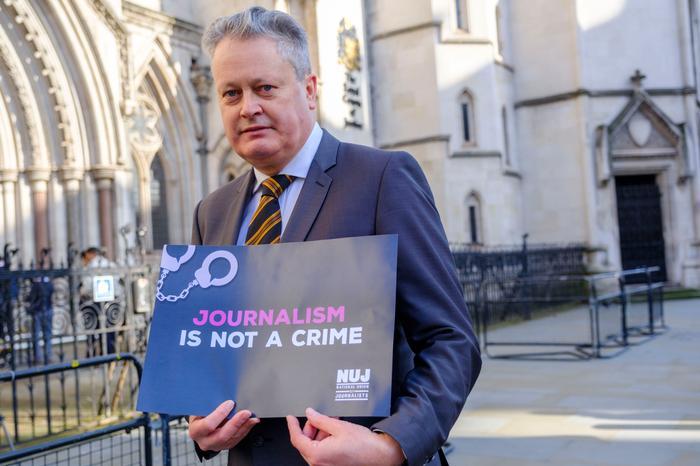
Vincent Kearney outside the Royal Courts of Justice in London.
© Jess Hurd
The PSNI said that the relevant legal framework at the time Kearney's rights were violated was later held to be inadequate in cases involving journalistic material and their counsel said “lessons had been learned”.
Kearney’s counsel Jude Bunting KC told the IPT there were seven separate police or MI5 operations in which communications data was unlawfully acquired over a period of more than ten years.
Information obtained included phone billing data and "subscriber names and address details" in respect of the numbers that had contacted Kearney.
MI5 conceded last year that it had breached Kearney's privacy rights by accessing his communications data in 2006 and 2009.
The IPT does not therefore have to determine whether Kearney’s rights were breached by MI5 but must decide what, if any, damages are to be awarded and if the BBC, his then employer, is also the victim of unlawful interferences of journalistic material by MI5.
The Metropolitan Police has also admitted unlawfully obtaining Kearney's data twice in 2012 and now we know that he was the target of unlawful surveillance by the PSNI between 2009 and 2014.
In relation to the PSNI, Bunting pointed out that the revelations only emerged because of the separate IPT case taken by Trevor Birney and Barry McCaffrey. It was an "accidental" discovery and over a long period Vincent and his family were unaware of the unlawful accessing of data by the police forces.
Bunting said the PSNI had displayed "an unhealthy" interest in journalists over many years.
He also stressed the impact of surveillance on Kearney’s professional and personal life, on his ability to do his job, on his reputation and on his relationship with sources.
In submissions Kearney said the snooping authorisations were “self-evidently not isolated events.”
“They reveal a systematic and years-long pattern of accessing my journalistic sources and mapping my professional activity,” he said.
“I am not aware of any other journalist in the UK or Ireland who has been targeted in such a sustained way over so many years.”
Kearney is currently Northern Ireland editor of RTÉ and a member of Belfast and District branch of the NUJ.
He was appointed home affairs correspondent with the BBC in Belfast in April 2006, a role he held until 2019.
He was accompanied at yesterday’s hearing by his wife and by Adam Smyth, BBC Northern Ireland director.
Smyth issued a clear message as he arrived in court. "The independence of the BBC is hard won and we will stop at no lengths to defend our journalism. What happened to Vincent Kearney was completely wrong. He was treated as a suspect, not as a journalist. His rights as a journalist were not respected."
On arrival he joined Laura Davison, NUJ general secretary, in a symbolic joint gesture of solidarity with Vincent.
Speaking to BBC News NI outside the court, Davison said: "Journalists have to be free to do their work in the public interest and we need to know what's happened here.”
“We need to know whether it's impacted other colleagues within the BBC. There has to be clear accountability and transparency in terms of what's taken place. We're calling for there to be a full public inquiry into surveillance of journalists in Northern Ireland, that has to be what comes out of this."