
TUC Congress 2026: unions support call for tech tax
TUC Congress expressed strong support to the NUJ's call for a 6% windfall tax on tech giants to reinvigorate the news sector.
This year’s Congress is taking place in Brighton from 13-16 September. The union's delegation is Laura Davison, general secretary; Fran McNulty, joint president; Natasha Hirst, Equality Council co-chair; Pennie Quinton, London Freelance branch chair; and Steve Bird, Newspapers and Agencies Council chair.
Taxing the tech giants
The first of two motions submitted by the union to this year's TUC Congress called on global tech giants who wield significant power over the media sector to pay their fair share in its preservation.
The likes of Google, Meta and X consume advertising revenue and control access to online information through AI summaries and the algorithmic curation of news. Tech companies have profited from the largescale theft of journalists’ work and supplanted trusted sources while failing to take responsibility for the discrimination, disinformation, and AI-generated fake news published on their platforms.
The NUJ's motion was composited with motions from UNISON, the National Union of Rail, Maritime and Transport Workers (RMT), and the Transport Salaried Staffs' Association (TSSA), which similarly urged the government to redistribute wealth from corporations to workers.
Speaking in support of the motion, Davison highlighted "swingeing cuts" to the BBC and other public service broadcasters as well as "relentless job cuts" at local news, with AI Overviews resulting in a huge loss of traffic and advertising for publishers.
At the same time, the NUJ General Secretary noted that "tech platforms have sucked up editorial content without making any contribution to its production." While welcoming the government's £12-million Local News Fund, she said that this alone was "not enough to fundamentally reset the sector."
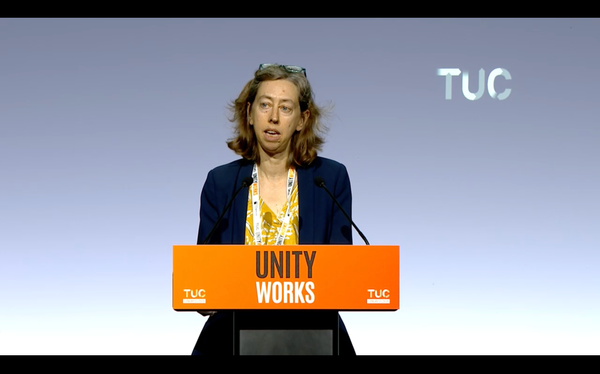
© Fran McNulty
Davison described a windfall tech tax as a "simple and practical step to generate funding" that could be reinvested "to protect jobs, improve conditions, and increase public access to quality news, retaining editorial independence". The motion also called for a strengthened digital services tax to sustain funding.
Davison said:
"The power wielded by billionaire tech owners must be redressed. Ethical journalism, strong public service journalism, local journalism are essential to all our work."
The composite motion carried unanimously.
Extending rights for freelances
Pennie Quinton spoke in support of Equity and Prospect's motion, 'Support for fully self-employed workers'. As chair of the NUJ's London Freelance branch, which represents around 4,000 members, Quinton highlighted the specific volatility and insecurity faced by freelance journalists.
Earlier this year the government held a consultation on whether freelance and self-employed workers should submit tax returns on a monthly rather than yearly basis. Quinton argued that any changes to income tax self-assessment "must be designed with an understanding of how journalists and other creative workers are paid and engaged" due to the unpredictable nature of freelance work and the significant delays members often experience in receiving payment.
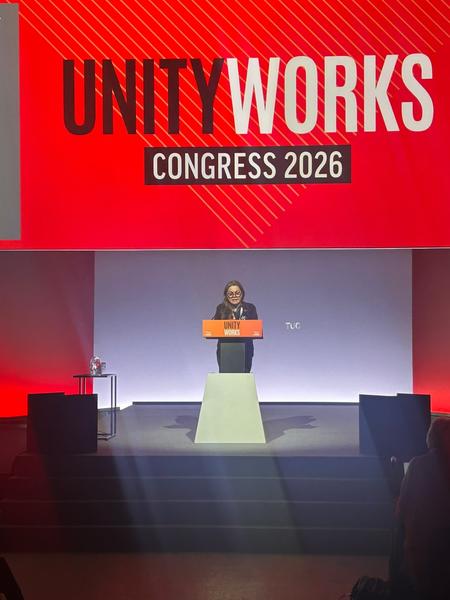
© Steve Bird
Quinton said:
“Tax systems designed around stable and predictable employment patterns risk creating unintended consequences for the large numbers of workers whose careers depend upon irregular, freelance work.
“Our members have expressed concerns at what this might mean in terms of their having taking time to administer tax each month during periods of intense deadline-focused work, such as reporting in conflict zones or working on travel-based assignments.”
The motion called on the TUC to campaign for the reforms to employment rights and income security for self-employed workers, and lobby the government to address various issues facing freelances - including unfair taxation, the gender pay gap, and lack of trade union protections. The motion carried.
Challenging far right narratives
At the TUC Women's Conference in March, the NUJ co-sponsored a composite motion on the rise of the far right and the weaponisation of women’s and girls’ safety in political discourse.
The composite motion was selected to go to TUC Congress and was discussed on the first day of the conference.
Natasha Hirst, NUJ Equality Council co-chair, stressed the work of journalists in scrutinising far right organisations and narratives. "Our members play a vital role in challenging the ideologies and actions of those who use oppression and discrimination as a tool to roll back the rights that we’ve all spent so long fighting for," she said.
This often means that journalists are targeted by the far right - both on social media and while covering public events. In April the NUJ published the first-year findings from the union's Journalists' Safety Tracker, which allows journalists to record incidents of intimidation, harassment, and violence. The findings uncovered what Hirst called "shocking reports" of violent, graphic abuse directed at Black, disabled and women journalists - including doxxing and daily death threats.
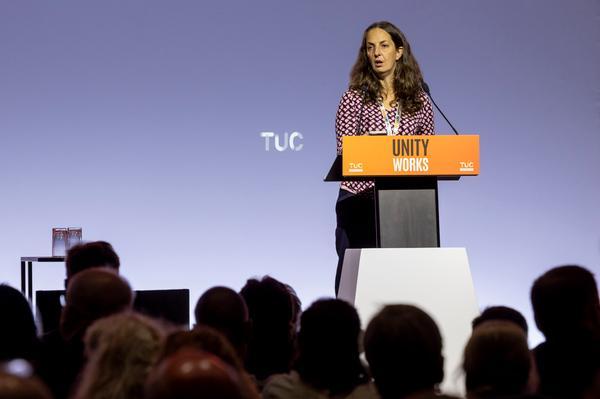
© Andy Aitchison
Hirst said:
"When the plurality of viewpoints in the press is shut down, it creates an echo chamber of hateful narratives, without counterpoints - and that harms all of us.
"As journalists and communications professionals, we bear a responsibility to follow [the union's] Code of Conduct, to report ethically, and to scrutinise and challenge narratives that seek to undermine the rights and safety of women and girls."
"It's increasingly challenging in the face of mass job cuts across our industry. Supporting our members to do their jobs well and protecting their safety at work is core to the NUJ’s mission. We also campaign for the press regulators to take stronger action to prevent discriminatory reporting.
"We can never be complacent about our rights, and our fight for equality and safety must be an intersectional and inclusive one."
The motion passed unanimously.
Supporting disabled workers
Hirst also spoke support of a motion from the TUC Disabled Workers' Conference in May on the government's plans to 'support people into work' by implementing damaging welfare reforms.
"This is a frightening time for disabled people in the UK. We are trying to survive in a society that does not value our lives," said Hirst.
The welfare system - Personal Independence Payments (PIP), Access to Work, Motability, Universal Credit - is incredibly complex. "If you’ve never had to navigate applying for the various benefits, concessions, schemes and grants, you will not have the expertise needed to pick apart the misuse of statistics or the harmful misrepresentation of disabled people’s lives," said Hirst, noting the role of journalists in countering misinformation and the need for more disabled people in the profession.
Hirst said:
"This kind of misinformation that we see in reporting is so hard to tackle because it often comes directly from politicians or it is contained within opinion pieces, which can be shaped by aggressive editorial lines and out of the control of individual journalists.
"We have a press regulator, IPSO, that consistently refuses to extend the editors code of practice to prevent discriminatory reporting against groups of people [...]
"The emergency for disabled people is not over. The attacks on our rights are endless and awful. We need your solidarity and your action."
The motion called on the TUC to work with disabled peoples’ organisation to urge the government to uphold disabled workers’ rights. The motion carried.