Ways to Make Journalism Pay
The NUJ London Freelance branch (LFB) held a successful all-day gathering on ‘Ways to Make Journalism Pay’ on 10 October.
Making money
Following an introduction by Pennie Quinton, LFB co-chair, the first panel of the day focused on making money, chaired by LFB’s Grace Livingstone. Susan Grossman, a mentor and travel writer, shared advice on securing assignments. As a former magazine editor who spent 15 years as a BBC Radio 4 presenter, Grossman stressed the importance of having confidence in your ability and work. She said that the nature of the industry required journalists to network and that the gathering was a perfect opportunity to ask questions, make contacts and secure commissions. "Journalism is all about not knowing much, but knowing someone who does. All you need is to find the right person to help you."
Steven Mathieson similarly encouraged attendees to value their work when pitching and negotiating fees. “It is not embarrassing to ask for too much,” he said. "It shows that you have confidence in your work.” As a former Guardian journalist with over 20 years’ experience as a freelance, Mathieson recommended making your pitch as succinct as possible and encouraged attendees to use NUJ resources, including the Freelance Fees Guide and Rate for the Job. The trainer also highlighted the array of courses - from data journalism to freelance tax - offered by NUJ Training Wales. Later in the session attendees received tax tips from Eric Longley, a tax specialist with years of expertise in the industry.
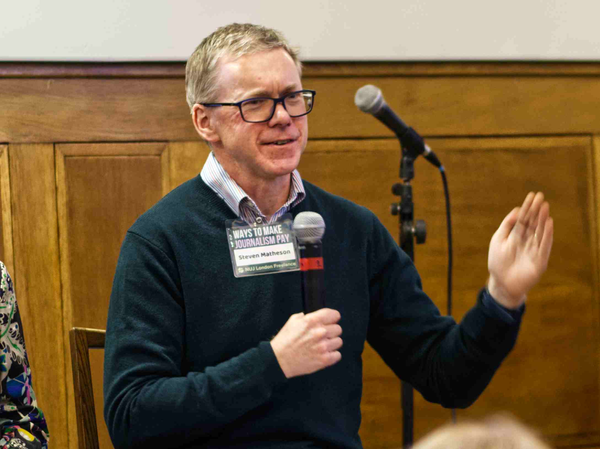
Steven Mathieson.
© Tim Dawson
Eleanor Mills described her transition to freelancing after 23 years at The Sunday Times. Mills said the initial experience was “horrible” - not helped by the headline of her Telegraph article: ‘On the Scrap Heap at 49’. However, she soon found that being self-employed offered an opportunity to become “a one-woman band”. Since going freelance Mills has founded Noon, an online media platform, and created the ‘Queenager’ newsletter to challenge the stereotypical narratives around women between 45 and 70. Mills emphasised that a good life is possible beyond tradition journalism. “This turned out to be one of the best things that ever happened to me.”
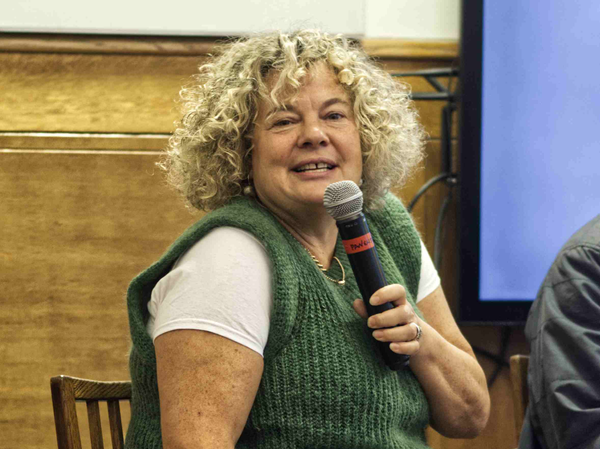
Eleanor Mills.
© Tim Dawson
Book publishing
The second session, chaired by National Executive Council (NEC) member Anna Hervé, focused on book publishing and self-publishing. The panel included Sarah Burton (Society of Authors). James Spackman (Book Pitch Doctor) and April Peake (Bloomsbury commissioning editor).
Hervé introduced the discussion by saying that members in book publishing were experiencing the same issues - from artificial intelligence to poor pay - as those in the rest of the sector.
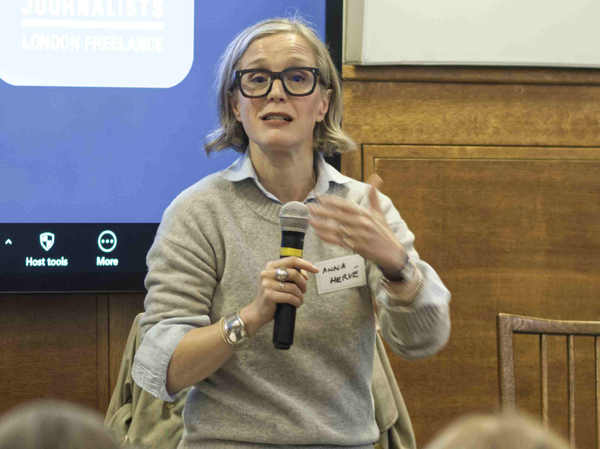
Anna Hervé.
© Tim Dawson
Some have found work through ghost-writing. Burton said ghost-writers can easily be exploited and noted the need for robust contracts. Hervé agreed that publishers can pay ghost-writers poorly and encouraged members to value your expertise and stand up for your interests.
The discussion moved to artificial intelligence and intellectual property. While expressing her rage at the scraping of writers’ work by the likes of Meta and the threat to journalists’ income, Hervé noted that licensing rights can generate passive income. Burton urged writers to retain certain rights, such as licensing for radio-plays or films. “It’s in your interests to licence narrowly whereas your publisher is likely to license broadly - so you’ll need to find a compromise,” she said. "Copyright [in book publishing] is like a cake – each way that your work can be exploited is like a different slice. Working out which rights to sell and which to hold back is vital".
Peake encouraged transparency and open conversations between writers and commissioning editors on licensing, saying that publishers do revert rights in certain circumstances. While AI can be used as an assistive tool, Peake urged extreme caution over the use of generative AI in the production of work.
Spackman spoke about the role of literary agents, who typically help writers sell their work for a 15% fee in the UK and 20% overseas. Some agents see their role as coaching authors and nurturing talent. Others are less involved in the editorial process but focus on securing a good deal for their clients. As a former author, Spackman sees his role as holding the publisher accountable for fulfilling their responsibilities and carefully scrutinising contracts.
Burton and Hervé similarly urged attendees to be professional, do your research and follow submission guidelines when pitching to agents and publishers. “We want to commission people who are good to work with and know their stuff.” Writers can find a register of bona fide agents from the Association of Authors’ Agents. Burton advised writers who are concerned about the theft of their work to explicitly state that you are pitching work in confidence. Authors looking for agents should study the acknowledgments in books in the subject area they are writing about.
Throughout the day NUJ trainers, reps and officials ran a series of one-to-one specialist surgeries on tax, pitching, digital journalism, and more.