
Spring Freelance Forum 2026
The vital role of professional journalists in covering courts was emphasised by Mr Justice David Barniville, president of the High Court in Ireland, at the Spring Freelance Forum organised by Dublin Freelance branch on Saturday.
In a detailed closing address to the forum, attended by almost 70 journalists and student journalists, Mr Justice Barniville said transparency in the administration of justice matters in navigating the tensions that can arise when seeking to balance full and open access with the need to safeguard the integrity of court processes.
Emphasising the role of court reports as the eyes and ears of citizens, he said: “In any constitutional democracy, the courts must necessarily be open, transparent and subject to public scrutiny. But, as we know, very few people get the opportunity to actually sit in a courtroom and observe the administration of justice firsthand. That is why the press plays such an indispensable role.”
Addressing the reporters present, Mr Justice Barniville said:
“Transparency builds trust and strengthens public confidence in the administration of justice. Indeed, courts rely on members of the public understanding not only what decisions are made but why they are made. We depend on you to communicate those decisions accurately, responsibly and in context.
“Your reporting in that regard ensures not only that justice is done, but that it is seen to be done and broadly understood. Your role in reporting on court hearings, and your right of access to in order to properly facilitate that work, is central to the proper functioning of an open, liberal democracy and to the rule of law. Accurate reporting enhances public understanding of the rule of law by demystifying proceedings that might otherwise appear opaque or inaccessible.”
The High Court president also addressed the issue of access to court papers by bona fide members of the press. He acknowledged the importance of ensuring that bona fide members of the press can readily access court papers so that reporting can be as accurate and informed as possible. This access is also a part of the principle of open justice. To support this, the Courts Service has guidelines in place to facilitate access to documents where permissible.
He said his door, and that of the Principal Registrar, is always open if bona fide journalists encounter difficulties in obtaining papers or wish to raise concerns about access.
Mr Justice Barniville said that with access comes responsibility. Journalists who receive copies of court documents must handle them with the utmost professionalism, discretion and respect for what can and cannot be published.
He said the NUJ's Code of Conduct and the Press Council of Ireland’s Code of Practice provide robust ethical frameworks that remind reporters of their duties in respect of accuracy and responsible use of information.
He added that media responsibility extends to all aspects of modern reporting.
Much like the media landscape, the courtroom environment has over the last number of years been reshaped by the widespread use of social media. While bona fide reporters, bound by professional standards of accuracy and fairness, can and do utilise social media as another reporting tool, others (including disruptive litigants and individuals with grievances) have attempted to weaponise social platforms by spreading misinformation or attempting to film, broadcast and/or mischaracterise proceedings.
He said he and his colleagues have witnessed an increasing number of incidents “whereby certain litigants, fuelled by anger or personal grievance, engage in repeated and sometimes outrageous attacks on the authority of the court - interrupting proceedings, refusing to comply with directions, or even shouting accusations such as calling a judge a liar in open court.”
Referring to recent cases by “some well-known and particularly disruptive litigants” he said such abuses of process have created new pressures on judges, court staff, lawyers and litigants.
The High Court president underlined the exercise of editorial judgement when reporting on extreme or persistent instances of disruptive behaviour in court.
He said: “When such behaviour occurs, it is of course generally newsworthy. But I would ask you to consider whether every inappropriate interaction merits publication.
“I am certainly not suggesting that misconduct of this kind, or outbursts in court, should be concealed. As experienced professionals, you have the capacity to distinguish between what informs the public and what merely amplifies behaviour designed to undermine the dignity of the court.”
Gerry Curran, NUJ joint president, addressed the event through his role as media relations advisor to the Courts Service. Curran said that it was important for court reporters to ensure stories were interesting and accessible while remaining accurate and objective with the essence of every article faithful to what was said in court. He drew attention to court rules limiting what can be reported and when.
Highlighting what makes a particular case stand out from the hundreds courts hear each day, he said that the major crimes will pick themselves but that so many other quirky cases can make great copy too. It is through listening and moving around the courts that reporters come upon these stories.
The Courts Service continues to provide daily assistance and information on court cases to reporters and Curran undertook to improve any areas where the press felt there were gaps and to give a longer online presentation to attendees at a future date.
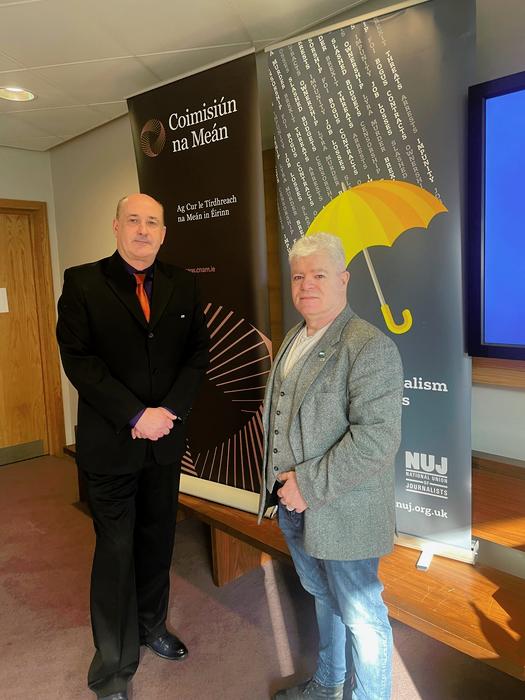
Gerry Curran, NUJ joint president, and Gerard Cunningham, Dublin Freelance branch chair.