
NUJ joins anti-SLAPP day of action
The NUJ has joined its partners in the UK Anti-SLAPP Coalition in a day of action to spread awareness of abusive legal threats and lawsuits.
Strategic Lawsuits Against Public Participation (SLAPPs) are abusive legal threats and lawsuits filed to silence critical speech. They can be targeted at journalists, whistleblowers, campaigners, academics, and more.
The NUJ has been campaigning for the UK government to take urgent action to prevent their use. Members can support the campaign by asking your MP to back provisions against abusive lawsuits in the King’s Speech using this adaptable template letter.
The NUJ is also seeking to document incidents of SLAPPs and other forms of lawfare against media workers through our Journalists’ Safety Tracker. Both members and non-members can use the Tracker to report an incident.
Laura Davison, NUJ general secretary, said:
“In a free society, journalists must have the ability to scrutinise, ask questions, and publish information in the public interest. SLAPPs are an attack on these very principles, giving those with financial power the ability to threaten and misuse the legal system to stymie reporting. Journalists and media organisations face complex lawsuits, which drain already limited time and resources. SLAPPs can even lead to self-censorship, with outlets avoiding certain stories for fear of being hit with baseless legal action that could tie them up for months or years. Current legal provisions to prevent SLAPPs simply fail to deal with the problem, and it’s time for the UK government to take decisive action.”
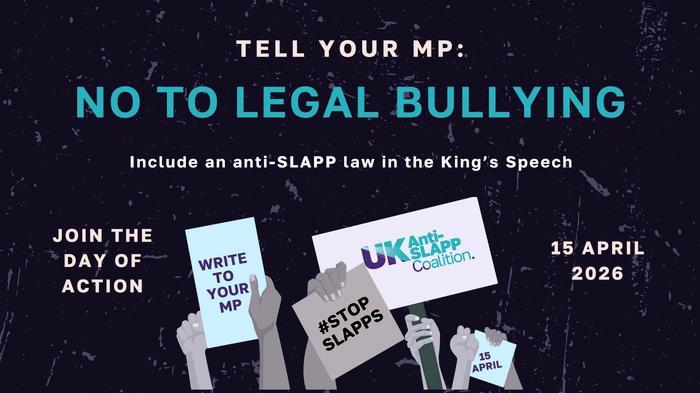
The UK Anti-SLAPP Coalition, made up of media organisations, lawyers, human rights defenders and other members of civil society, has published the following op-ed to mark the day of action:
Journalists do not become journalists to prepare for court hearings. They join newsrooms, submit FOI requests, ask questions, report from council hearings and courts, and speak to as many people as they can because they have a story to tell. They also know that local communities do better when there is more information in the public domain, not less.
Journalism is vital for local democracy to hold power in check and give a voice to the community, ensuring no one is beyond scrutiny. However, unchecked wealth and influence has a powerful ally in its quest to prevent questions being asked and sheltering itself from uncomfortable attention; the British justice system. Abusive lawsuits, sometimes called Strategic Lawsuits Against Public Participation (SLAPPs), allow those with money to threaten costly and time-intensive court action to prevent reporting being made public or to force published work from the public eye.
Abusive lawsuits are not genuine attempts to address flaws in the journalist’s work. Indeed, many journalists are sued just for asking questions or requesting comment from someone who has not even read the piece before deciding to sue them. SLAPPs are attempts to silence reporting and cordon off those deserving of scrutiny from any form of public accountability.
All forms of journalism are vulnerable to this sort of abuse from legal bullies. For investigating Putin’s rise to power, Catherine Belton was threatened by multiple Russian oligarchs and a Russian state oil company; Paul Radu, the co-founder of OCCRP, was sued by an Azerbaijan MP in London even though neither are based in the UK; and the UK Treasury were only too happy to allow disgraced and sanctioned Russian warlord Yevgeny Prigozhin to sue Bellingcat founder, Eliot Higgins.
But these sorts of tactics are not limited to national or international outlets alone.
Right now, two local Mill Media outlets, in Liverpool and London, are currently facing complex legal challenges solely due to their reporting. These are two small outlets, and dealing with these types of abusive legal threats takes up a disproportionate amount of their resources, hindering their ability to inform their readers. Of the legal action against The Londoner, which has included threats of prison time, Joshi Herrmann, the founder and editor of Mill Media said that it “makes this city a difficult place to do investigative journalism”, while Cormac Kehoe who wrote the piece fears being “financially ruined” by the legal onslaught. Many other local outlets across this country may be facing the exact same jeopardy but are fearful that by going public, by drawing their readers’ attention to the legal action, they could make things worse for themselves. As a result, we may never know the full scale of the issue, yet we must take action.
Journalists are not the only ones who can be targeted to spike a story. SLAPPs have been used against survivors of sexual assault who have named their attackers to warn other women; they have been used against local campaigners working tirelessly to improve public services for themselves and their neighbours; they have been used against former patients who have posted reviews to inform others exploring potential medical treatment; they have been used against environmentalists fighting to protect endangered species and eco-systems from corporate greed; they have been used against tenants who have the temerity to request repairs are made in good time and that complaints are taken seriously. In fact, there are few areas of society untouched by this form of legalised bullying and so we have to ask - who has been threatened into silence, so much so that they are too fearful to speak to a journalist?
SLAPPs remove information from the public domain. Every story, social media post, blog, report or published piece of work removed by a target who cannot afford to mount a defence, cannot afford to turn away from their work to prepare going to court, and cannot afford to endure the complexity and unpredictability of the British justice system, is something that leaves us all worse off.
However, next month the government has an opportunity to re-address the balance to ensure that those targeted by legal bullies have the same right to justice as those wealthy enough to afford the legal costs. If the King’s Speech includes a Bill that will establish universal, clear and meaningful anti-SLAPP protections, we know legislative time will be put aside for Parliamentarians to take an important step for the rights of everyone to speak out.