
Artificial intelligence: journalism before algorithms
The NUJ's AI campaign calls for urgent regulatory oversight promoting ethical approaches that centre the work of journalists.
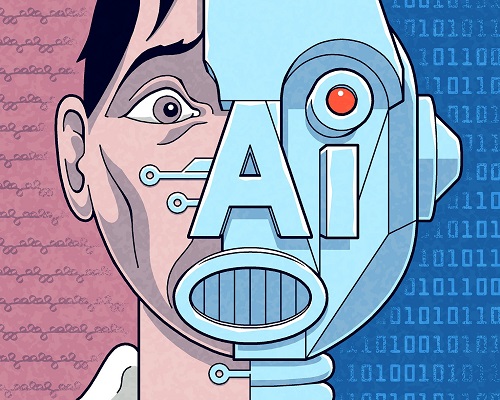
Protect journalists' rights
The NUJ is calling for fast paced developments within AI to include engagement with journalists and those whose work is used in the technology. Threats of exploitation and intellectual property rights breaches have already been realised, with reports of inaccurate data used to inform AI generated stories, false attributions to journalists, and creators discovering use of their likeness without their knowledge or consent. Such advancements in the use of AI directly threaten journalism and risks the reputation of every journalist abiding by ethical standards to ensure accuracy and honesty through their work. We need greater transparency on the data sources used to inform and train generative AI technologies.
The NUJ is engaging with sister unions including members of the Broadcasting, Entertainment and Arts Unions, on AI’s impact on journalists and creators across industries. The union also engages with the Trades Union Congress including through its Creative Sector AI Working Group. In August 2026, we wrote to Kanisha Narayan MP, UK Minister for artificial intelligence, and members' concerns have been represented to decision makers in both the UK and Ireland.
We are a member of the Creative Rights In AI Coalition and previously held a seat on the UK government's AI and copyright Working Group.
Journalism by humans remains at the core of our calls to employers and governments. We have urged the UK government to engage with the union as Ministers shape policy that has huge implications for journalists and journalism. The NUJ must be central to discussions on decision making to ensure the voice of members including your concerns on pay, job security, and rights infringements are considered and used to inform guidance.
As the use of AI is explored by employers, the NUJ is firm in its stance that valuing journalism by humans will ensure the role of journalists in upholding democracy, publishing stories in the public interest and holding the powerful to account is trusted. The union is engaging with employers considering ways to include or expand their use of AI across workplaces. Encouraging employers to draft key principles focused on ethical approaches, these must be shared with journalists and the union in meaningful engagement.
Read the 'AI for public good' section in the NUJ's News Recovery Plan.
FAQs
There is no universally accepted definition of AI. The UK government states, “AI can be defined as the use of digital technology to create systems capable of performing tasks commonly thought to require intelligence.”
Generative AI is a type of artificial intelligence capable of creating new content in forms including text and images. Generative AI learns from data input into systems, noting their patterns and structures, resulting in output that appears to be created by humans.
LLMs are a type of generative AI able to predict new text by using vast data sets to understand and generate new content. LLMs cannot recognise whether their output is accurate and when errors occur these are called “hallucinations.” One of the most popular examples of a large language model is OpenAI’s ChatGPT, trained on 300 billion words obtained from the internet.
When used ethically and with transparency, AI presents opportunities for good. The NUJ is keen to engage with employers on policies as they consider implementing AI tools into workflows.
AI could improve accessibility for disabled people e.g. generative AI produced alt text or visual data descriptions, supporting a wider group of people to engage with images.
Key Issues
AI generated journalism cannot replace the talent, creativity or skill sets held by journalists. The use of AI must be considered against a background of pay stagnation, below-inflation wage increases, under-staffed newsrooms, and growing redundancies. Threats to journalists’ jobs are at the forefront of minds, and although many are already adapting to developments, governments and employers must recognise the benefits of a human-centred approach and invest in skills and training that considers the long-term sustainability of journalism. This includes adopting calls in the NUJ’s News Recovery Plan stressing the importance and value of local news to communities.
Governments must recognise the role of AI in the spread of misinformation and disinformation, particularly in the context of election periods. Examples of political figures falling victim to deepfake technology has already occurred and been viewed by large audiences on social media.
When an article titled “Should refugees in Ireland go home?” was published across titles owned by the Iconic Media Group, clickbait was used on a subject the ChatGPT generated piece failed to consider in detail. The union reaffirmed its position that AI is no substitute for genuine journalism.
NUJ Photographers' Council statement
The NUJ is concerned with protecting editorial integrity in visual journalism. Journalistic images and footage should be an unaltered and accurate reflection of what was in front of the lens when the shutter button or record button was pressed.
The NUJ Code of Conduct provides a commitment to producing ethical and accurate journalism, including visual media.
Basic edits to an image such as sharpening and toning or removing dust spots are acceptable. Journalistic images should not contain AI-generated elements or deletions of parts of the image which were present when the image was taken. It is vital that people can trust the accuracy and integrity of journalistic images and footage that are published or broadcast by media outlets, wires and agencies.
The NUJ endorses the Content Authenticity Initiative which provides open source software that embeds information in an image to allow its provenance and any manipulations to be permanently recorded within the file.
The NUJ has responded to UK government consultations outlining concerns including on the sources of training data used by tech giants, the impact on freelances and photographers. The NUJ has previously held a seat on AI and copyright Working Groups hosted by former governments.
The NUJ recognises that the fast-paced nature of AI requires clear frameworks that hold developers to high ethical standards with clear sanctions for breaches. A focus on innovation should not come at the expense of robust ethical AI practices and to the detriment of journalists whose rights are disregarded. We are calling on current Ministers to ensure sufficient protections for rightsholders.
The UK government must introduce mandatory legislative frameworks requiring developers to adhere to agreed standards, protecting journalists and their rights. There is an urgent need for strengthened legal frameworks that hold developers to account and create accessible methods to seek redress where journalists’ rights are breached. Journalists across the UK & Ireland including freelances, must have access to information on how their content can be removed by platforms unlawfully using material.
The NUJ has briefed the NUJ Parliamentary Group formed of cross-party MPs with our calls. We continue to raise members' concerns through structures in Ireland.
In March 2026, the union welcomed confirmation from the UK government that it no longer supported an opt-out exception to copyright for artificial intelligence training. Laura Davison, NUJ general secretary, recognised "the unregulated deployment of artificial intelligence is not an abstract threat but a real danger across our sector, with members reporting increased drudgery, ‘content’ demands, and the largescale theft of their work." Read her quote in full.
NUJ submission to the UK government’s Copyright and Artificial Intelligence consultation
February 2025 submission to the Intellectual Property Office.
NUJ submission to the Getty Shutterstock merger inquiry
NUJ comment submission to the Competition and Markets Authority’s Getty Images/ Shutterstock merger inquiry.
NUJ submission to UK government call for evidence on AI and Copyright
The NUJ has responded to the Department for Culture, Media & Sport’s call for evidence on AI licensing and copyright in creative industries.
Ireland
Séamus Dooley, NUJ assistant general secretary, giving evidence to the Joint Oireachtas Committee on AI and copyright. said: “Tech companies should be obliged to disclose their training data, the design of their algorithms and their output, and pay their fair share for the wholescale robbery of creative workers’ labour.” Watch Dooley at the evidence session.
The EU AI Act was signed by presidents of the European parliament and European union and published in the EU's Official Journal on 12 July 2024. Providers and developers whose output falls within the EU must adhere to the Act, irrespective of their location and the Act prohibits certain AI practices, classifying some systems as high-risk with specific requirements in place. Where breaches occur fines can be issued, and are set as a percentage of the company's global annual turnover in the previous financial year or a predetermined amount, whichever is higher. The union responded to the European AI Office's consultation on trustworthy general-purpose AI models in the context of the AI Act.
The EU General-Purpose AI Code of Practice includes chapters on transparency, copyright and safety and security. Signatories to the Code are on a voluntary basis and agree to draw up and implement a policy to comply with EU copyright law for all general purpose AI models, making this publicly available. There is, however, no mandatory requirement to do so. Signatories include OpenAI and Anthropic.
The NUJ has previously raised concerns over journalists’ right to redress should their content be used by AI models. Read more from the union on the Act.
Natasha Hirst, NUJ president and chair of the union's photographers’ council, presented a paper at The Royal Photographic Society’s conference on artificial intelligence in October 2023, where topics included ethical issues around AI generated photography and intellectual property rights.
Hirst emphasised that "copyright is the lifeblood of the creative industries" and stressed the importance of protecting livelihoods. The NUJ’s AI campaign calls for the intellectual property rights of photographers to be respected at all times. Although the creativity and skill sets photographers hold cannot be replicated by AI, new technologies pose a threat to the professional reputation of members.
The NUJ engages with the National Police Chiefs’ Council, representing safety concerns relayed by photographers and videographers. As AI generated images without labelling on their creation using technologies spreads, there is growing concern possible threats to journalists’ safety.
Last year, Shutterstock announced it would provide the artificial intelligence company OpenAI, with access to its video, image and music libraries, allowing customers to edit and alter images. The NUJ has grave concerns about the impact of this approach on copyright owners and repeats its call for informed, transparent processes with creators fairly compensated for use of their works.
The NUJ calls for any agreements between media owners and AI companies to ensure licensing arrangements include representative organisations and agreements that allow journalists to receive fair payment for their work.
The union is liaising closely with the International Federation of Journalists, who have also called for the inclusion of journalists and representative bodies to be involved in discussions held between publishers and developers. The IFJ has stressed the need for “democratic discussion about how humanity can benefit from AI and how we can regulate its operation.”
Read the IFJ calls to action on AI adopted by its executive committee in June. They feature the need for:
- An ability to organise and bargain collectively with AI companies with respect to the terms for use of journalists' work in generative AI language models and outputs
- Compensation for ingestion and use that has already occurred
- The need for international regulation of AI
- Training to use new technology made available to all
Resources
Guidance for NUJ members including on rights and copyright ownership.
Freelance fess guide
Rights and why they are important

Copyright for journalists and writers
This booklet is for people who are trying to make a living by creative work, particularly journalism.
Latest News
Template AI contract clause
Template contract clause agreed by the NUJ's Photographers' council on use of works in informing and training artificial intelligence technologies.

MPs call for investment in public service journalism
MPs have urged the UK government to protect public service journalism and address the distorting effects of social media and artificial intelligence.
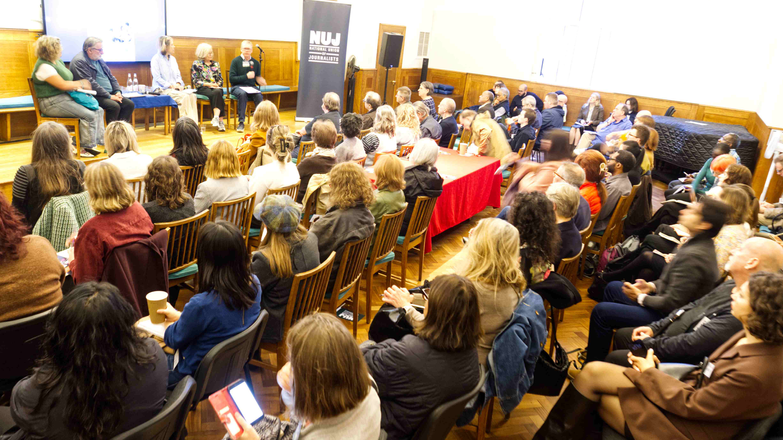
Ways to Make Journalism Pay
The NUJ London Freelance branch (LFB) held a successful all-day gathering on ‘Ways to Make Journalism Pay’ on 10 October.
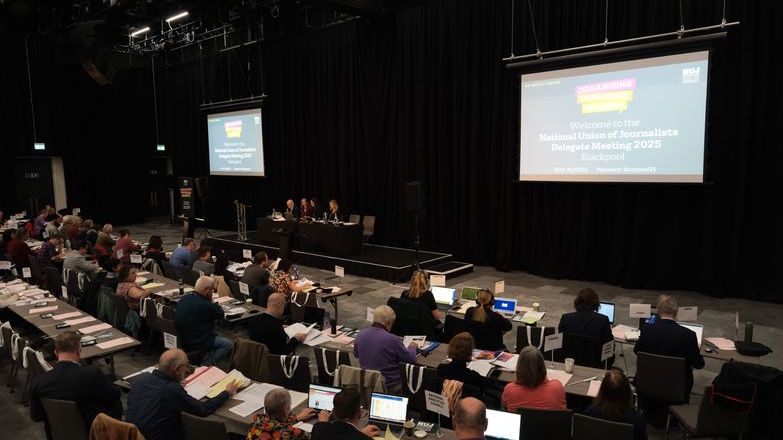
Delegate Meeting 2027 explainer
What should the NUJ campaign on? What issues matter most to journalists and media workers? And what should the union be doing to support its members i...
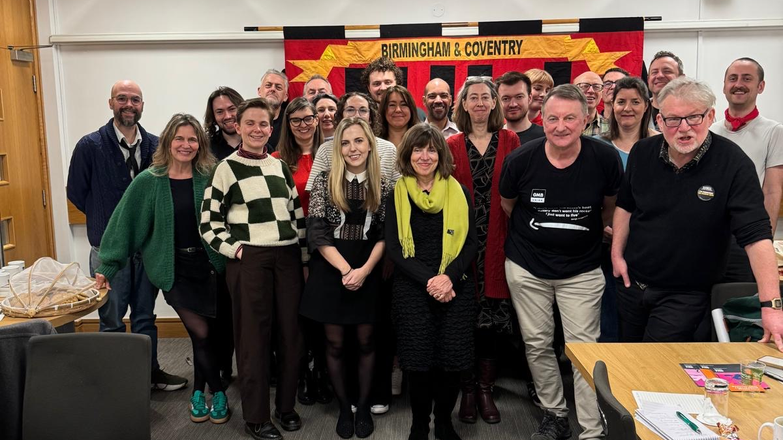
Publishing reps hold successful summit
The NUJ Newspaper & Agencies Council (NAC) held a national summit for reps in the publishing sector on Saturday 14 March in Birmingham.