
NUJ and fellow unions take ‘Back Our BBC’ campaign to Westminster
On 24 November, the NUJ and sister unions sent a delegation to Westminster to raise awareness of large-scale cuts to the BBC and urge parliamentarians to protect the broadcaster and its workers.
The Broadcasting, Entertainment & Arts Unions (BEAU) – made up of Bectu, Equity, the Musicians’ Union, the NUJ and Writers Guild of Great Britain (WGGB) – has been collectively campaigning to secure a brighter future for the BBC through Charter Renewal.
The unions have been pushing for universal long-term funding, stronger worker protections, and much-needed regulatory reforms - including worker representation on the BBC board. BEAU has also been calling for the BBC to stop its devastating programme of cuts to jobs and valued programming.
Dozens of members, reps, secondees, and leaders from the unions took these calls to the UK Parliament, with some securing direct talks with their representatives to win their support. Numerous MPs from across the political spectrum held “I Back Our BBC” posters and placards and committed to raising the issue of cuts and the need for investment on the floor in Westminster.
BEAU group photo outside Parliament
© Jess Hurd
Kim Johnson MP holding "I Back Our BBC" poster
© Jess Hurd
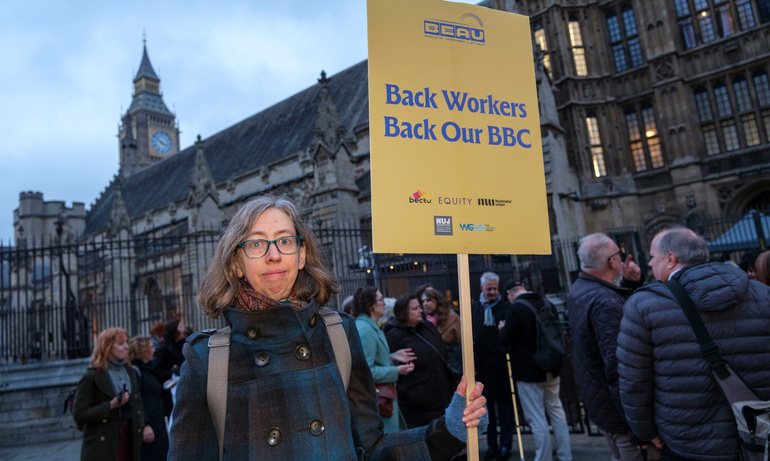
Laura Davison outside UK Parliament
© Jess Hurd
BEAU panel event in Parliament
© Jess Hurd
MPs in BEAU panel session
© Jess Hurd
Q&A during BEAU panel session
© Jess Hurd
A panel and Q&A session, chaired by Kim Johnson MP, in Parliament at the end of the night also drew in a crowd of parliamentarians.
Speaking on the panel, Laura Davison, NUJ general secretary, said:
“It’s our BBC – we’re workers, we’re licence fee payers, and we’re here to stand up for the organisation and sound the alarm. This is a very serious moment. We’ve become accustomed to hearing about cuts at the BBC over a long period of time. But the cuts we’re seeing now are of a different magnitude in terms of the impact on job losses, workloads, and programming.
“Collectively, it’s our responsibility to stop that happening and to mitigate the impact of what’s coming and to stand up for workers at the BBC and the licence fee payer. The power of all of us coming together as unions with the turnout today shows what we can do.”
Naomi Pohl, Musicians' Union general secretary, said that the BBC is the largest employer of musicians in the UK. But budget cuts over the years have impacted pay for members at the broadcaster, leading to the loss of opportunities for young talent and diminishing the availability of services.
She added: “We need a new funding package and the shoring up of the organisation for the future. We want to see a permanent Charter so that the BBC isn’t constantly in this position of having to fight for itself. The government has that power now – let’s preserve our BBC so it’s there for generations to come.”
Paul W Fleming, Equity general secretary, compared the BBC to the NHS, particularly in its role as one of the largest employers. He added that throughout Charter Renewal the government must “look at the BBC as an economic driver as well as a valuable social service – the jewel in the crown of the welfare state.”
Seynam Kluvitse, a Bectu lay official, said:
"Repeated rounds of cuts and restructuring have already reduced capacity across production, journalism, and technical operations – resulting in intensified workloads, the loss of specialist expertise, and increasing pressures on the workforce. These cuts do not stop at the BBC - they affect independent production companies, freelancers, suppliers, local economies, and the wider creative workforce. The central question should not be how much the BBC costs, but how we fund the kind of BBC the UK wants, needs, and deserves."
Lisa Holdsworth, WGGB TV Committee chair, said:
“We must join Ofcom in calling on the BBC to provide a comprehensive timetable and impact assessment of planned cuts. If the government considers the creative industry to be a priority sector of the economy, as stated in the 2025 Industrial Strategy, it must act to defend the largest employer of writers and other creative freelancers in the UK. It must protect the opportunities and training the BBC provides. It must ensure the BBC is still able to reflect the lives, interests and concerns of people across Britain.”
MPs in the room during the panel session also spoke about the importance of the BBC to them and their constituents and committed to working to protect it.
Rebecca Long-Bailey MP, NUJ parliamentary group chair, said:
“This is more than just about opposing cuts - it’s about securing the future of the BBC. It’s important because in an age of disinformation, when a lie can spread on social media in a matter of seconds, the BBC is the last bulwark we have to defend truth and democracy. We’ve got to fight for it.”
John McDonnell MP, NUJ parliamentary group secretary, said:
“We know that if [the BBC] gets rid of these programmes, it'll just keep going for more. The danger is you can get to a position where an organisation just implodes – it no longer exists. We have to do our job of alerting our constituents to this threat - and that’s what we’ll do.
“We must also lobby government. A spending review is taking place, and we must impress upon ministers the need for funding the BBC. Taking back full funding for the World Service and free licences for over-75s are some of the things the government can do that will relieve some of the pressure on the BBC.”